


On April 1, 2026, Super-Kamiokande marked the 30th anniversary of the start of its observations. To commemorate this milestone, the Institute for Cosmic Ray Research (ICRR) of The University of Tokyo held a symposium and celebration on May 23 in Toyama City, Toyama Prefecture. Approximately 270 participants attended, including representatives from the Ministry of Education, Culture, Sports, Science and Technology (MEXT), universities, local governments, community stakeholders, and researchers.
The Kamioka Observatory began operation of the large water Cherenkov detector, Super-Kamiokande, in April 1996, located 1,000 meters underground in the Kamioka Mine in Hida City, Gifu Prefecture. Since then, it has produced numerous achievements in particle physics and astrophysics, including studies of atmospheric and solar neutrinos, searches for proton decay, and the development of supernova neutrino observation networks.
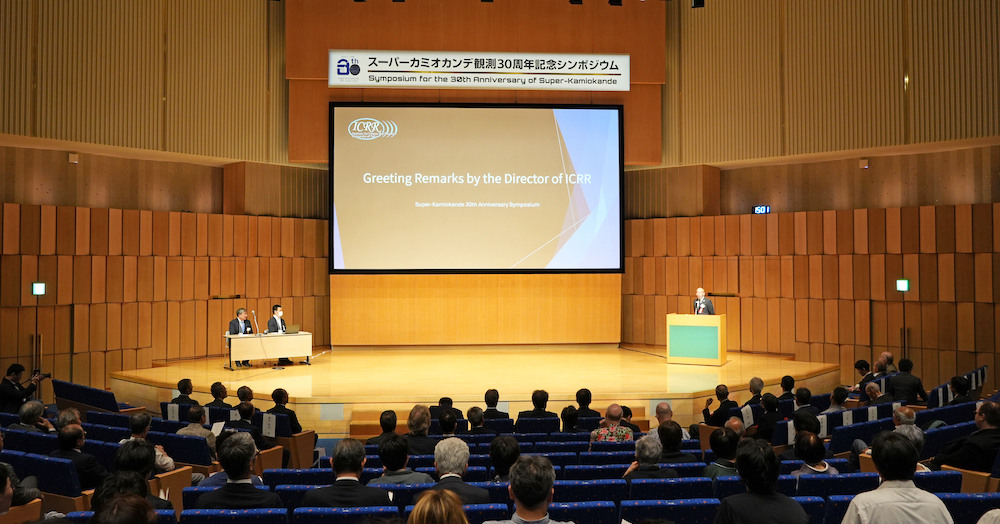
Symposium Overview
The symposium looked back on the Super-Kamiokande’s achievements over the past 30 years and discussed future prospects. At the opening, Shoichi Ogio , Director of ICRR, expressed gratitude to all those who have supported the research over the years. Teruo Fujii , President of The University of Tokyo, stated that Super-Kamiokande embodies the university’s mission of serving to the global public good and reaffirmed the university’s commitment to advancing the project. Takashi Fuchigami, Director-General of the Research Promotion Bureau at MEXT, emphasized that this research has showcased the high level of Japan’s academic and scientific capabilities to the world and expressed hopes for continued progress in the field. Tie Luo, Directorate Head of the Mathematical and Physical Sciences Directorate at the U.S. National Science Foundation (remarks delivered by Professor Henry Sobel), highly praised the project as a model of sustained international collaboration.
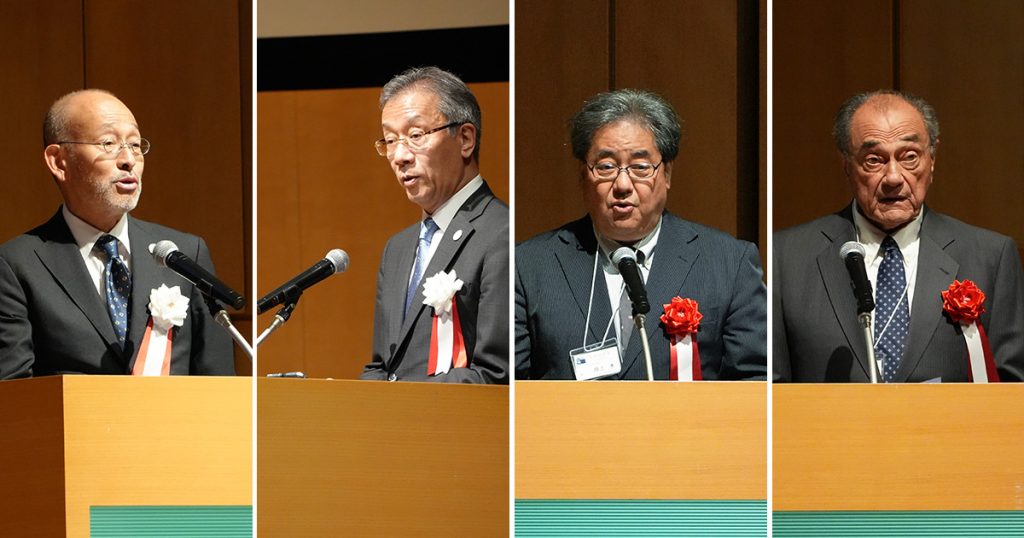 From left: Director Shoichi Ogio, President Teruo Fujii, Director-General Takashi Fuchigami, and Professor Henry Sobel
Scientific Presentations: 30 Years of Achievements and Future Outlook
A wide range of scientific results was presented during the session. At the beginning, Hiroyuki Sekiya, spokesperson of Super-Kamiokande, noted that the observation of supernova neutrinos had been one of the key goals in the original proposal. He reviewed the development of the detector and observations over the past 30 years, explaining that long-term observations have produced major scientific achievements while also helping train generations of researchers.
He also expressed gratitude, stating:
“Super-Kamiokande has been built and operated through the collective efforts of many collaborating companies and researchers working together at the underground site in Kamioka. The numerous scientific achievements over the past 30 years have been made possible thanks to close collaboration among all stakeholders and the strong support of the local community.”
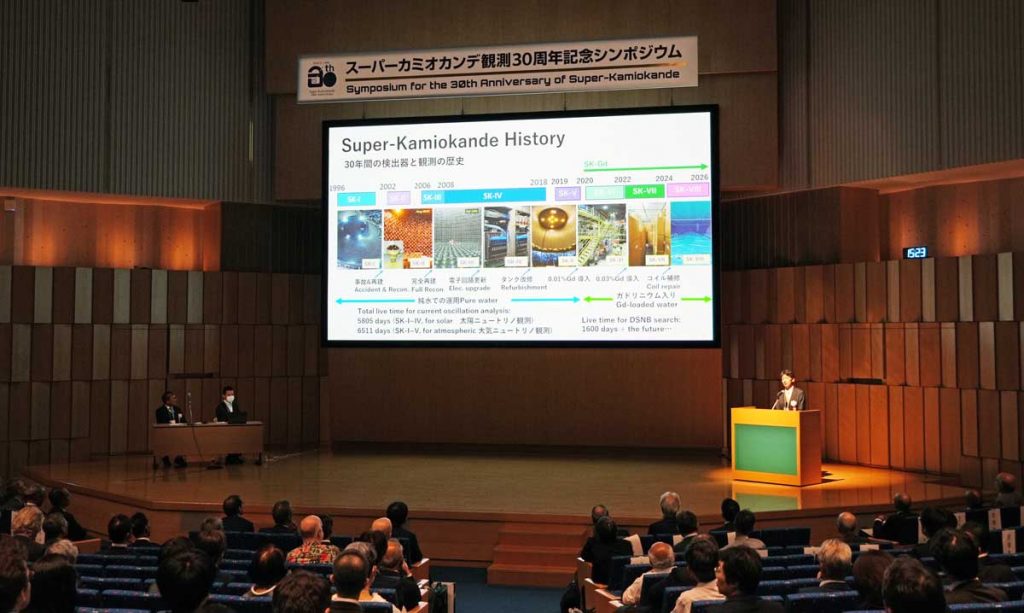 Hiroyuki Sekiya, Spokesperson of Super-Kamiokande reviews the history of Super-Kamiokande.
Professor Edward Kearns of Boston University reviewed the history of international collaboration, explaining how Japanese and U.S. research groups came together to build an enduring international collaboration.
Professor Roger Wendell of Kyoto University discussed how atmospheric neutrino oscillation studies have advanced to the stage of precision measurement, and emphasized that searches for proton decay continue with the world’s highest sensitivity.
Professor Michael Smy of the University of California, Irvine, reported that, following the discovery of solar neutrino oscillations, continued data accumulation and improved observation techniques have enabled increasingly precise measurements.
Professor Ken Sakashita of KEK introduced the discovery of muon-to-electron neutrino oscillations in the T2K experiment, along with developments of near detectors and beam intensity enhancements, and expressed strong motivation for Hyper-Kamiokande.
Professor Masato Shiozawa, Director of the Kamioka Observatory and co-spokesperson of Hyper-Kamiokande, presented the construction status of Hyper-Kamiokande and expressed the vision of building on decades of accumulated knowledge and technology to open a new era of particle physics.
Professor John Beacom of The Ohio State University highlighted that the ongoing SK-Gd project is the detector closest to discovering the diffuse supernova neutrino background, expressing expectations for its scientific impact.
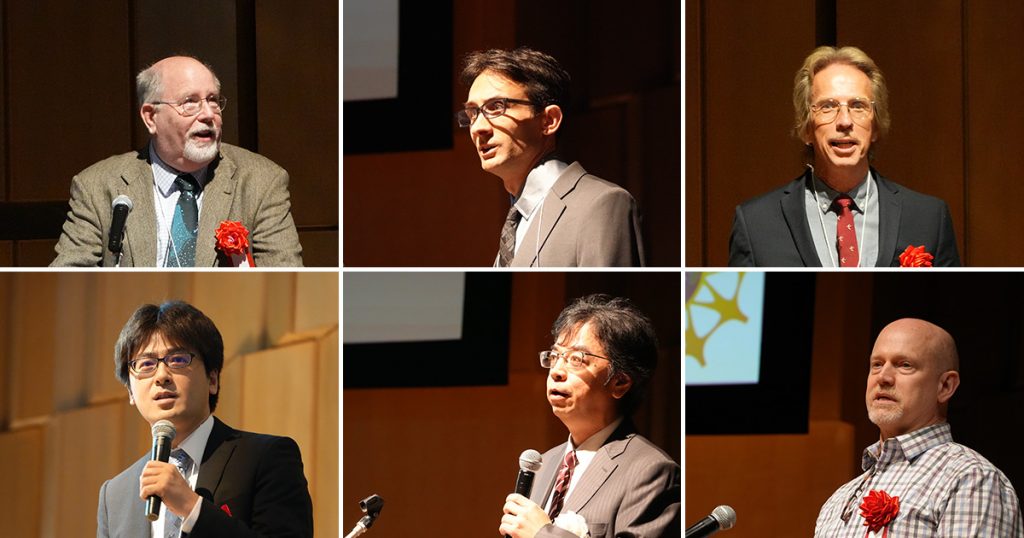
Top row, from left: Professor Edward Kearns, Professor Roger Wendell, and Professor Michael Smy. Bottom row, from left: Professor Ken Sakashita, Professor Masato Shiozawa, and Professor John Beacom
Associate Professor Sekiya returned to the stage to explain in detail the progress and results leading up to the SK-Gd project. He noted that signs of the diffuse supernova neutrino background are beginning to emerge in data after the introduction of gadolinium, and expressed expectations for future analyses.
He also outlined prospects for realizing multi-messenger supernova astronomy through dramatically improved supernova pointing capabilities, in coordination with global observation networks, and reaffirmed the commitment to exploring new views of the universe.
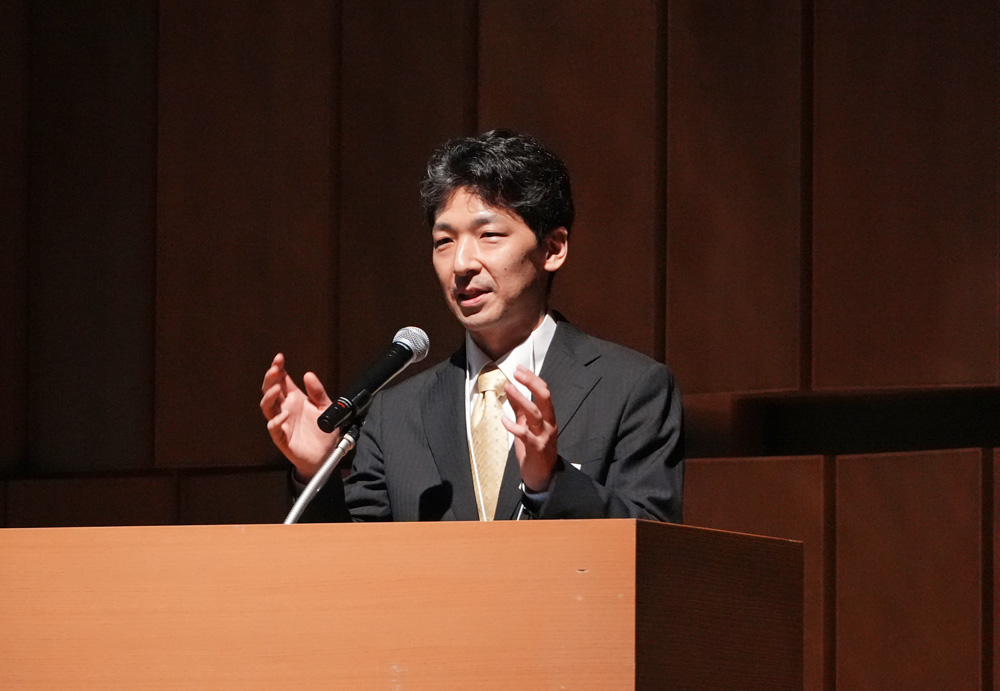
Hiroyuki Sekiya, Spokesperson of The Super-Kamiokande collaboration
Celebration
The celebration began in a warm and festive atmosphere with opening remarks by President Fujii. Junya Tsuzuku, Mayor of Hida City, delivered congratulatory remarks, expressing pride in Super-Kamiokande as a symbol of the region. Following a ceremonial “Kagami-biraki” (sake barrel opening) by representatives, a toast was led by Jiro Arafune, Professor Emeritus of The University of Tokyo.
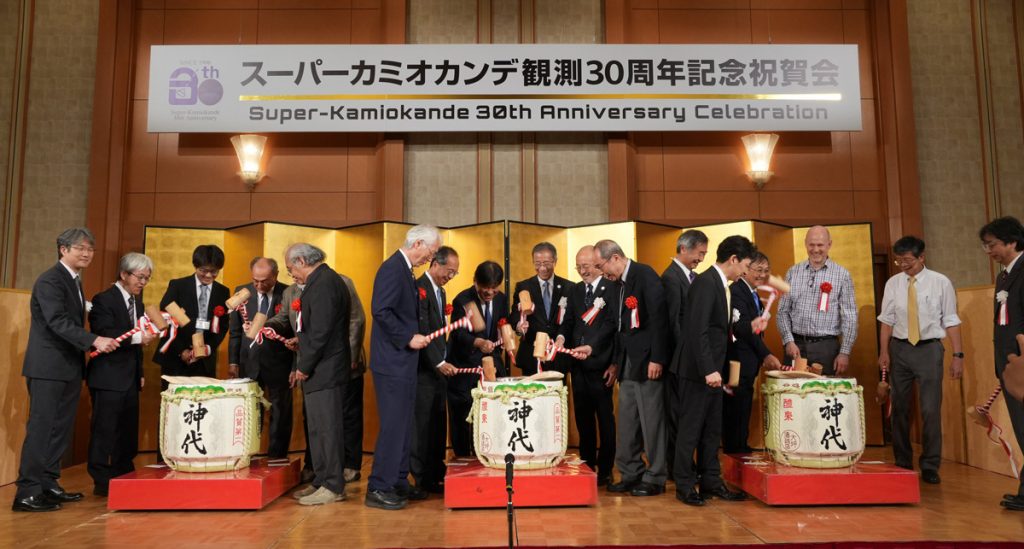 Kagami-biraki
Midway through the event, a traditional “Kamioka Edo Kiyari” performance by the Kamioka Edo Kiyari Preservation Society energized the venue, highlighting the close ties between the local community and the scientific project. Further congratulatory messages were delivered by Naohito Saito, Director of KEK’s Institute of Particle and Nuclear Studies; Mamoru Doi, Director-General of the National Astronomical Observatory of Japan; and Hirotaka Sugawara, Professor Emeritus of KEK, each reflecting on the project’s history from their respective perspectives.
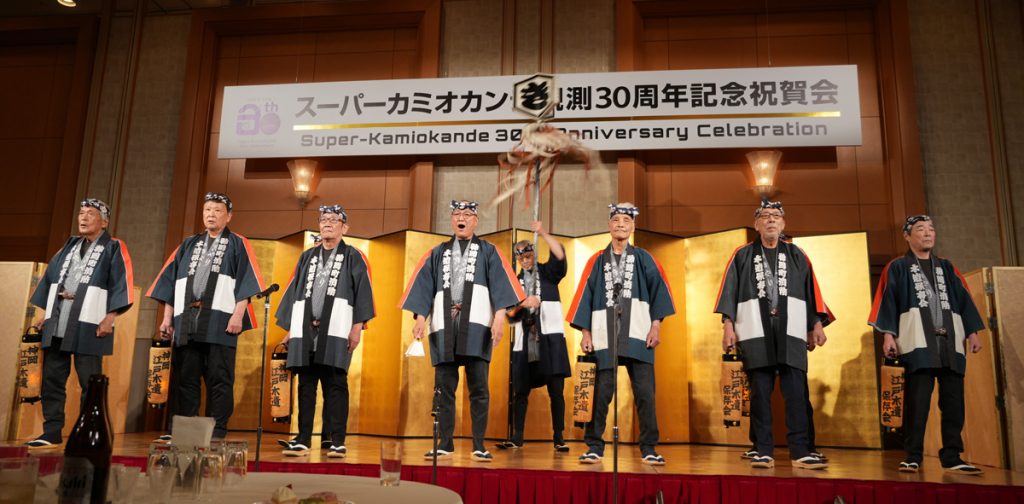
Kamioka Edo Kiyari Performance
In closing, Director Shiozawa summarized the 30-year journey as the result of unified efforts between researchers and the local community, highlighting continuous challenges and evolution. He expressed determination to continue disseminating research achievements from Kamioka to the world, bringing the successful event to a close.
Links
30 Years of Super-Kamiokande Operations
Super-Kamiokande 30th Anniversary Symposium website
30th Anniversary Commemorative Film “Super-Kamiokande: 30years of Discovery and the Path Forward”


