


The University of Tokyo
Tokyo Metropolitan University
Kyoto University
Key Highghts
◆We have identified the physical origin of “mode branching and disappearance” in the characteristic oscillations (quasinormal modes) of gravitational waves emitted by rotating black holes, resolving a puzzle that remained unexplained for nearly 40 years.
◆We have shown that mode branching can be explained by an “avoided crossing” with another mode and resonant excitation, while mode disappearance results from “pole skipping,” in which a pole representing an oscillation mode is canceled by a zero associated with a thermal frequency.
◆Our findings demonstrate that both poles and zeros are essential to understanding black hole oscillations, offering a new perspective that connects gravitational-wave black hole spectroscopy with non-Hermitian physics and finite-temperature many-body physics.
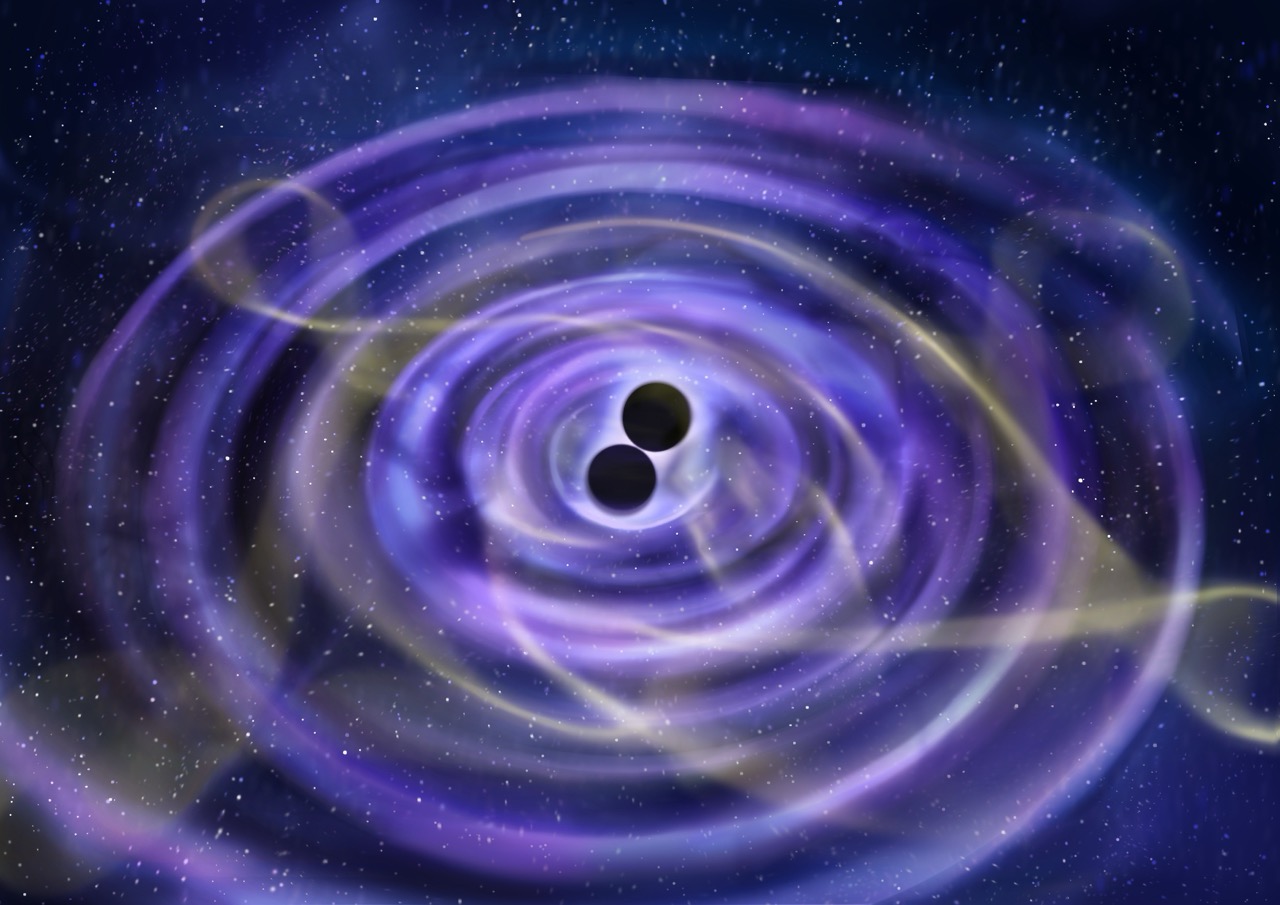 Schematic illustration of this study, which reveals the origin of the characteristic oscillations in gravitational waves from binary black hole mergers
【Summary】
A research team comprising Kei-ichiro Kubota, Project Researcher at the Institute for Cosmic Ray Research, the University of Tokyo, and Hayato Motohashi, Associate Professor at the Graduate School of Science, Tokyo Metropolitan University, has used theoretical analysis and numerical calculations to uncover the origin of anomalous behavior long known near special frequencies in the quasinormal modes of rotating black holes. For nearly 40 years, certain oscillation modes have been known to appear to split into two or disappear as the black hole’s spin is varied. In this study, the researchers tracked both the poles, which correspond to oscillation modes, and the zeros, which have the opposite property, of the Green’s function describing the black hole’s response across multiple Riemann sheets (Note 1; Fig. 1). They showed that the apparent branching arises from an avoided crossing (Note 2) with another mode and the associated resonant excitation, while the apparent disappearance results from pole skipping (Note 3), in which a pole and a zero coincide and cancel each other. These zeros are also linked to thermal frequencies determined by the black hole’s Hawking temperature and other parameters. These findings deepen the theoretical understanding of gravitational-wave black hole spectroscopy and offer a new perspective connecting black hole physics with non-Hermitian physics and finite-temperature many-body physics.
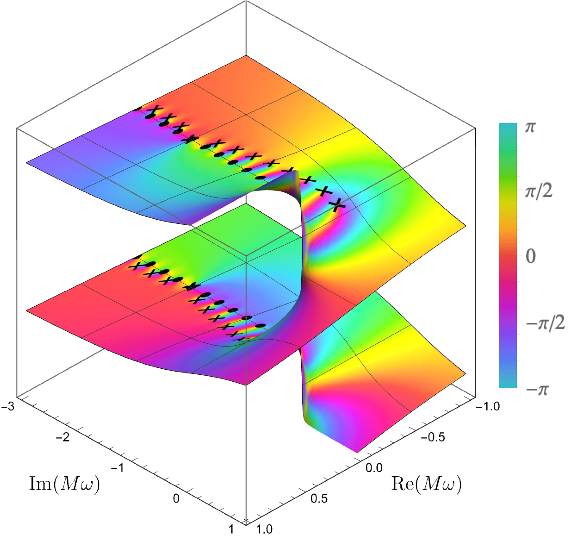
Figure 1: Riemann sheets in the complex frequency plane describing the black hole’s response
Colors indicate the phase of the response, crosses mark poles corresponding to quasinormal modes, and dots mark zeros corresponding to thermal frequencies.Examining multiple Riemann sheets allows us to track modes on sheets that were hidden in conventional analyses.
【Resarch Overview】
After a binary black hole merger, the remnant settles into a stable rotating black hole, emitting gravitational waves with characteristic oscillations, much like a bell ringing after it is struck (Fig. 2). This phase, known as “ringdown,” is primarily described as a superposition of quasinormal modes, which are oscillations that decay over time. Because the frequencies of these modes are determined by the black hole’s mass and spin, they form the basis of “black hole spectroscopy,” which uses gravitational waves to probe black hole properties and test general relativity.
However, quasinormal modes of rotating black holes have long been known to exhibit puzzling behavior near special frequencies called “algebraically special frequencies” (Note 4). Modes appear to split into two, disappear abruptly, or fail to connect smoothly to the limit of zero black hole spin. Although these phenomena were identified in early studies nearly 40 years ago, a comprehensive understanding of these phenomena and their physical origins was still lacking.
In this study, we extended the conventional approach of tracking only the poles of the Green’s function that characterize quasinormal modes by simultaneously tracking its zeros, where the response vanishes (Note 5). We also examined in detail how these poles and zeros move across multiple Riemann sheets in complex frequency space (Fig. 1).
As shown in Figs. 3 and 4, we found that the apparent splitting of a single mode into two arises from an “avoided crossing”: two modes on different Riemann sheets approach each other and repel without crossing. We also clearly confirmed behavior characteristic of avoided crossings, identified in recent studies, in the modes found here. Furthermore, we showed that this avoided crossing is accompanied by “resonant excitation,” which greatly enhances the excitation of the modes.
The apparent disappearance of a mode as the black hole’s spin approaches zero, meanwhile, can be explained by “pole skipping.” In this process, a pole representing a quasinormal mode coincides exactly with a zero at a special frequency related to the black hole’s thermal properties, known as a “Matsubara frequency” (Note 6), and the two cancel each other. We also confirmed that similar phenomena occur in modes with higher multipole orders.
These results demonstrate that correctly understanding the oscillation spectrum of a black hole requires examining both the trajectories of the poles representing the modes and their interactions with zeros. This study refines the theoretical foundations of black hole spectroscopy using gravitational waves. It also demonstrates that the dynamics of poles and zeros play an important role in black hole oscillations. These dynamics are currently attracting attention in the physics of non-Hermitian systems, which examines the complex spectra of open systems, as well as in scattering theory and studies of thermal Green’s functions.
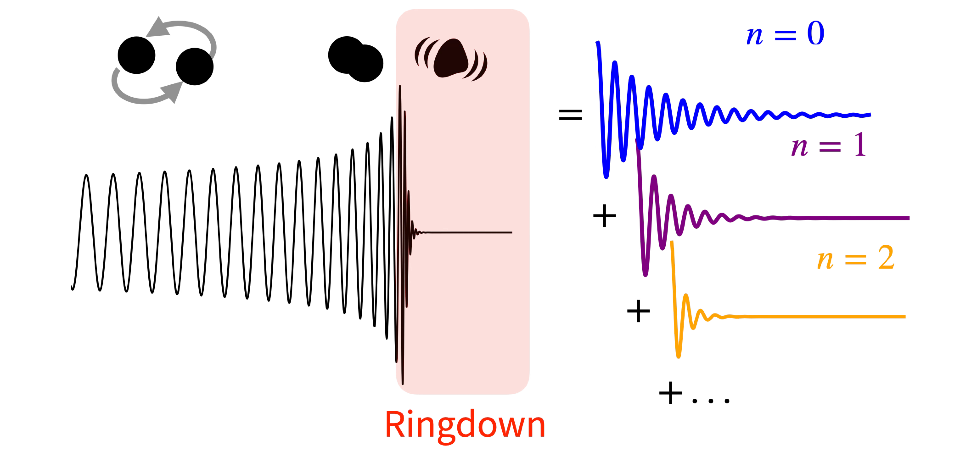
Figure 2: Schematic illustration of gravitational waves from a binary black hole merger
A binary black hole system loses energy through gravitational-wave emission. As the orbit shrinks, the frequency increases until the black holes collide and merge. After the merger, the system emits characteristic gravitational waves known as “ringdown” as it settles from a perturbed state into a stationary black hole. These ringdown gravitational waves are described as a superposition of “quasinormal modes,” the characteristic damped oscillations of the black hole.
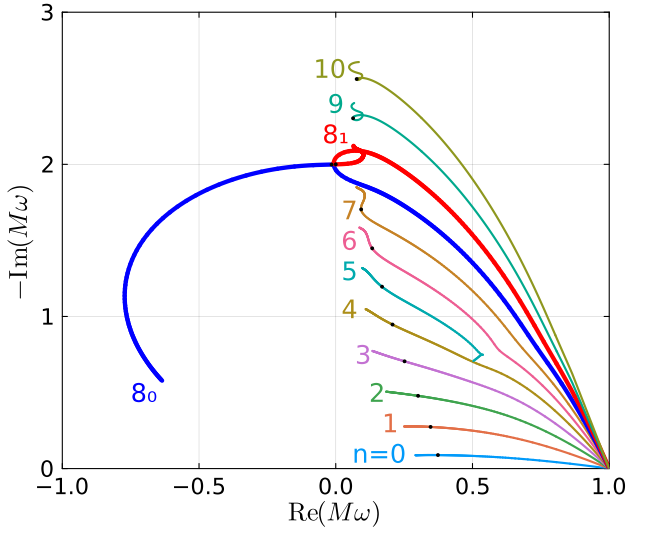
Figure 3: Quasinormal-mode trajectories as the black hole’s spin is varied
The horizontal and vertical axes show the quasinormal-mode frequency and damping rate, respectively, normalized by the black hole’s mass, as its angular momentum is varied. The right half shows the previously known spectrum, while the left half shows the spectrum newly revealed in this study. The blue and red curves are the focus of this study.
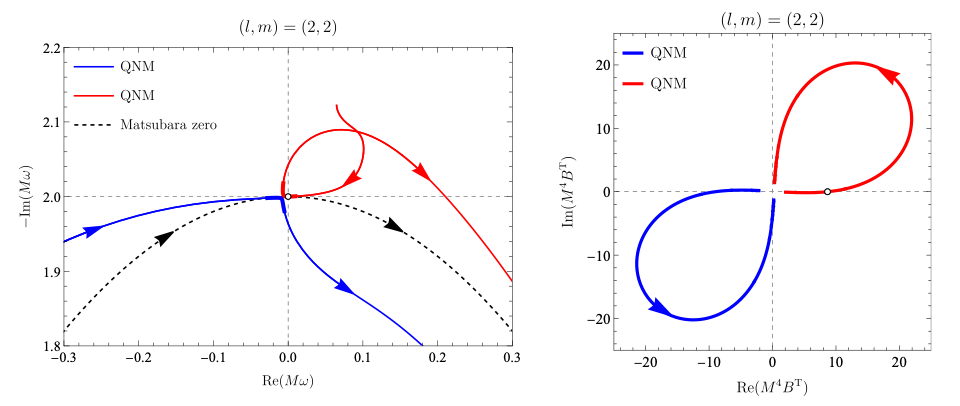 Figure 4: Enlarged view of quasinormal-mode trajectories (left) and excitation-factor trajectories (right) as the black hole’s spin is varied
The left panel shows an enlarged view of the quasinormal-mode frequency and damping-rate trajectories in Fig. 3 near the “algebraically special frequency” (white circle), which is the focus of this study. The red and blue curves correspond to those in Fig. 3. The right panel shows the excitation factors, which quantify how readily each mode is excited, in the complex plane as the black hole’s angular momentum is varied. The thick segments in both panels correspond to the same range of angular momentum. An “avoided crossing” occurs when quasinormal-mode frequencies approach each other but then move apart as if repelled, without crossing. Associate Professor Hayato Motohashi, a coauthor of this study, recently showed that the frequency trajectories trace hyperbolas, while the excitation-factor trajectories trace lemniscate curves. These features are clearly visible in the avoided crossing identified in this study (thick segments). Furthermore, at the algebraically special frequency marked by the white circle, the pole traced by the red curve collides with the zero traced by the black dashed curve, resulting in “pole skipping.”
【Key Highghts】
Journal: Physical Review D
Title: Pole Skipping, Avoided Crossing, and Resonant Excitation in Kerr Quasinormal Modes near Algebraically Special Frequencies
Authors: Kei-ichiro Kubota, Hayato Motohashi
DOI: doi.org/10.1103/29n2-dsmr
URL: https://doi.org/10.1103/29n2-dsmr
【Glossary】
(Note 1) Riemann surface
A mathematical structure consisting of multiple “sheets,” introduced to treat a multivalued complex function as a single continuous structure. In this study, we tracked quasinormal modes not only on the conventionally studied sheet but also on another sheet.
(Note 2) Avoided crossing
A phenomenon in which the frequencies of two modes approach each other but their trajectories bend as if they repel one another, instead of crossing. It is known in fields such as non-Hermitian physics, which describes open systems.
(Note 3) Pole skipping
A phenomenon in which a pole and a zero collide at the same frequency and cancel each other, causing the pole to disappear.
(Note 4) Algebraically special frequency
A frequency at which solutions to the equations governing gravitational perturbations around a black hole have special mathematical properties. The anomalous behavior of the quasinormal modes investigated in this study occurs near this frequency.
(Note 5) Poles and zeros of the Green’s function
The Green’s function describes how a black hole responds to an external stimulus. A “pole” is a special frequency at which the response becomes extremely large and corresponds to a quasinormal mode. A “zero” is the counterpart of a pole, at which the response vanishes.
(Note 6) Matsubara frequencies
Characteristic frequencies that arise in quantum systems at finite temperature. Because black holes also have a temperature (Hawking temperature), corresponding Matsubara frequencies can be defined.
Link
“Thirty-year mystery of dissonance in the ‘ringing’ of black holes explained” (2025-04-26)


